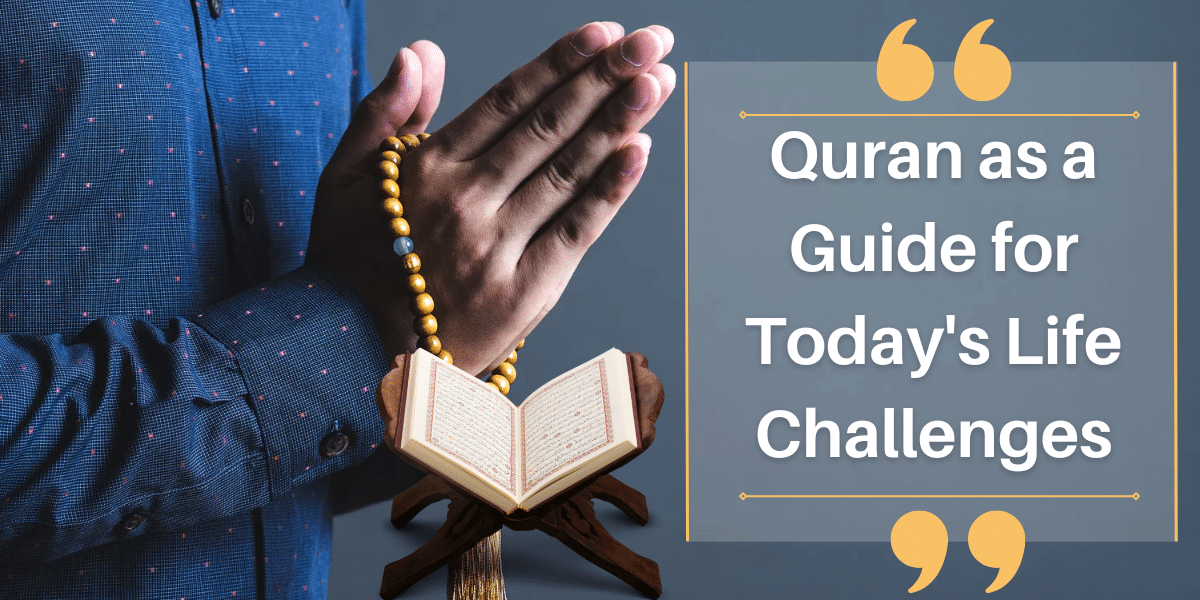
Quran as a Guide For Today’s Life Challenges
The Quran, the Islamic holy book, is abounding with time-tested wisdom that could be used to counter life challenges. Far from being a religious book, it is a manual of guidance on self-development, mental health, and moral decision-making. With the fast pace of today’s life, individuals are confronted with an array of issues, stress and anxiety, ethical concerns, and a search for meaning.
This blog discusses how the Quran acts as a solution to overcoming the problems of contemporary life through wisdom and mercy.

Finding Inner Peace in the World of Stress
Modern life is increasingly identified with stress. Work stress, financial issues, and social pressure are debilitating. The Quran addresses this by emphasizing inner peace on the grounds of religion and awareness. Surah Ash-Sharh (94:5-6) reminds us, “With hardship comes ease.” The verse advises us to keep going, reassuring the believers that hardship is temporary and followed by ease.
As a discipline, the Quran offers training in terms of prayer (Salah) and supplication (Dua). This exercise gives individuals moments of reflection and guidance to a higher purpose. Continuous prayer, recited five times a day, acts as a mental refresh of a kind, soothing anxiety, and causing peace of mind. Exercise in mindfulness lowers the level of cortisol, and repetition that comes with Salah replicates the effect. By utilizing Quranic passages and looking at themselves, they can learn patience and trust in Allah’s timing to relieve pressure on the mind.
Ethical Decision-Making in an Uncertain World
Today’s ethical issues range from professional matters in the workplace to knowing how technology influences relationships. A book of ethics is the Quran, where justice, mercy, and truth are embedded. Surah Al-Ma’idah says (5:8), “Be just; that is nearer to righteousness.” Such an ethic can be used for everyday decision-making, whether with coworkers, family members, or strangers.
For instance, in commerce, the Quran does not mislead and encourages truthful trade. Prophet Muhammad (peace be upon him) proved this by being referred to as “Al-Amin” (the trustworthy). That is truthful and transparent business, no misleading others, and keeping moral behavior over profit. Based on decisions taken based on Quranic values, one can solve moral problems with honesty, earning other human beings trust and respect.
Mental illness based on depression and anxiety is on the rise. The Quran provides an emotional strength model in the form of a call to hope and faith in God. Surah Ad-Duha (93:3) testifies, “Your Lord has not forsaken you, nor has He become displeased.” This testimony transcends feelings of abandonment or hopelessness and brings one to a sense of self-worth.
The Quran also instructs one to take care of one another, requesting believers to care for one another. Generosity and kindness sustain human relationships, eradicating loneliness, an overbearing characteristic of mental illness. Volunteering or helping the neighbor, for example, replicates the Quranic command to “spend in the way of Allah” (Surah Al-Baqarah, 2:261). The recipient will gain, but it also gives meaning and defeats despair in the giver.
Materialism and consumerism rule today’s society, most of the time leading to dissatisfaction. The Quran warns us against following worldly material prosperity, yet to be satisfied with the eternal. Surah Al-Kahf (18:46) states, “Wealth and children are the adornments of this worldly life, but the everlasting good deeds are better.” This mentality allows one to follow higher aspirations in life, something other than worldly matters.

In practice, it entails technology boundary-making, gratitude practice, and investment in relationships. The Quranic exhortation not to be excessive (Surah Al-Furqan, 25:67) calls for a middle path in life, neither too much nor lack of too little personal requirement. By learning from these principles, people can cultivate contentment, liberating themselves from the burden of “keeping up” with the world.
Modern life could strain family and community relations with busy timetables and intrusions of modern communication machines. The Quran puts a significant weight on human-to-human relations, requiring parents, wives, and neighbors to be respected and honored. Surah An-Nisa (4:36) warns, “Worship Allah and associate nothing with Him, and be good to parents and relatives.”
Adopting this, families can share good times, such as meals or prayer times, to practice closeness. The Quran also encourages resolving conflicts through patience and kindness, for the sake of harmony. For example, Surah Ash-Sharh (94:1-2) reads removal of loads, which can build compassionate communication in conflicts. More unity creates a support system, where one may suffer in life with collective strength.
Overcoming Uncertainty with Faith
Doubt regarding career, health, or the world will freeze decision-making. The Quran encourages reliance upon God’s wisdom, or Tawakkul. Surah At-Talaq (65:3) assures, “Whoever puts his trust in Allah, He is Sufficient for him.” Faith enables a person to take action without paralysis due to the unknown.
Tawakkul is not passivity but a strategy of balance: hard work in preparation and relinquishing outcomes outside one’s control. A job applicant, for instance, can prepare well for interviews but assume that the outcome is in concordance with divine will. This mindset eradicates anxiety and generates confidence, enabling an active response to uncertainty.

Conclusion: A Timeless Guide for Today
The Quran’s teachings are universal, grappling with today’s problems such as stress, ethical crises, mental disorders, and broken relations. Its focus on faith, balance, and community offers a pattern for purposeful living and perseverance. Living by Quranic values—prayer, ethical decision-making, or acts of charity—humans can meet the intricacy of life with purpose and optimism. For the sake of sanity or peace, the Quran remains a credible friend who smoothes paths to successful living in modern times.