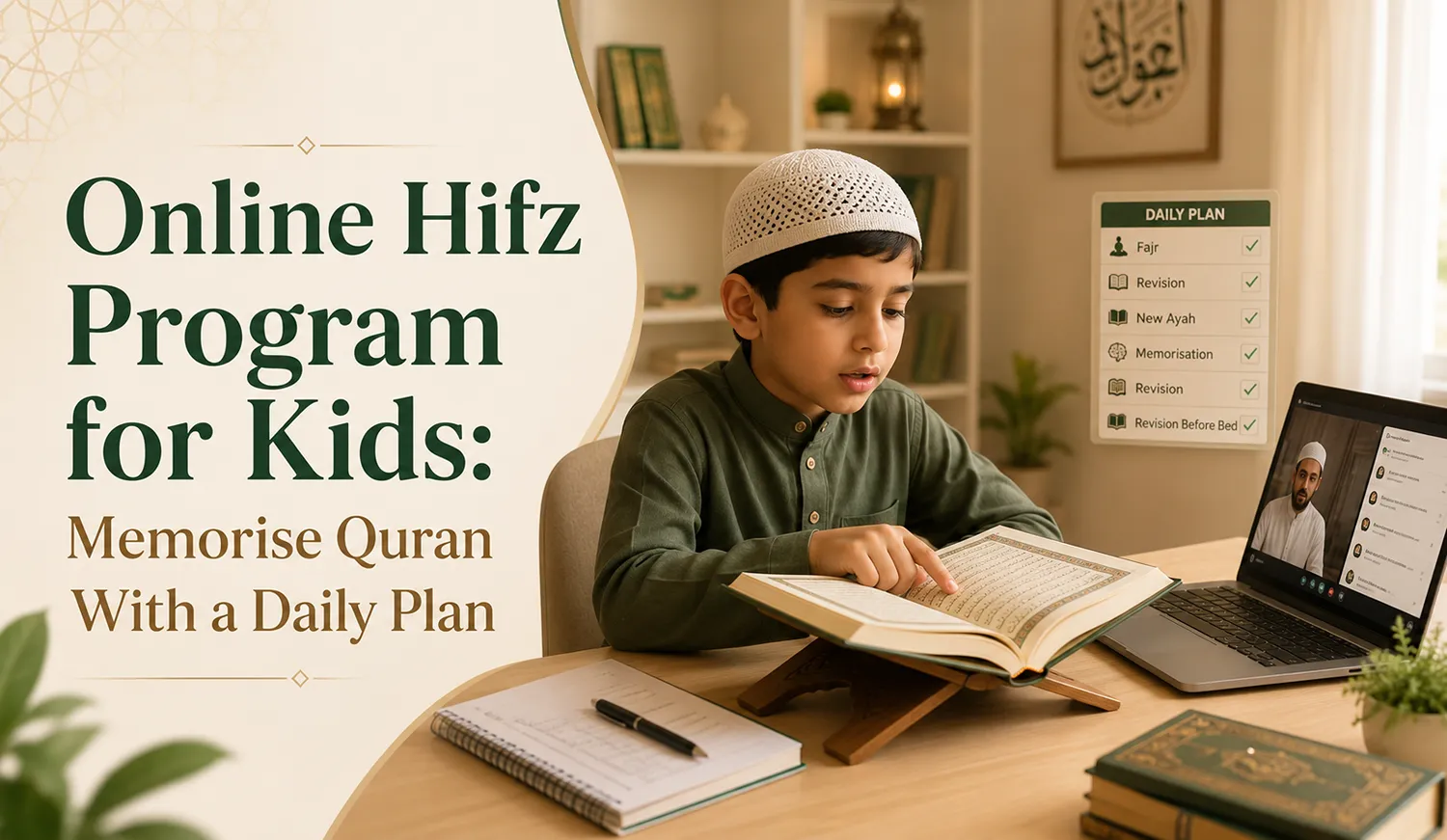
Online Hifz Program for Kids: Memorise Quran With a Daily Plan
Every parent who dreams of raising a Hafiz asks the same quiet question: is my child too young, and will this actually stick? The good news is that memorising the Quran does not need a big travel plan or a strict boarding madrasa. With the right daily rhythm and a patient teacher, a child can start small at home and build a full Hifz over a few steady years. An online Hifz program for kids makes that path realistic for busy families, whether you live in London, Toronto, Sydney, or a small town with no local Hafiz nearby.
This guide walks you through how the program works, the daily plan that keeps memorisation from slipping, honest timelines, and what to look for before you enrol.
What Is an Online Hifz Program for Kids?
An online Hifz program for kids is a structured Quran memorization course taught one-to-one over live video, where a qualified teacher guides your child through new memorization, daily revision, and long-term review on a fixed schedule. Lessons run from home, usually 30 to 60 minutes, and progress is tracked so parents can see exactly where their child stands each week.
Hifz simply means committing the Quran to memory, and a child who completes it is called a Hafiz (for a girl, Hafiza). It is a serious commitment, but it is broken into tiny daily pieces so it never feels crushing. If your family is completely new to structured study, our online Hifz classes page explains the levels in plain language.
How Does the Daily Hifz Plan Work?
The daily plan is built on three moving parts that run every single lesson: new memorization (Sabaq), recent revision (Sabqi), and old revision (Manzil). This spaced structure is what turns short-term recall into permanent memory, and it mirrors how memory research says the brain actually retains information over time, through spaced repetition.
Here is what a typical day looks like for a young beginner.
| Part of the lesson | What the child does | Rough time |
| New memorization (Sabaq) | Learns a few new lines with the teacher | 15 to 20 minutes |
| Recent revision (Sabqi) | Revises the last 5 to 7 days of lessons | 10 minutes |
| Old revision (Manzil) | Recites older memorized portions in a loop | 10 minutes |
| Tajweed correction | Teacher fixes pronunciation as they go | Woven throughout |
New portions stay small on purpose. A four-line target that is truly solid beats a full page that falls apart by Friday. As the child grows and their memory muscle strengthens, the daily portion increases naturally. Good Quran memorization for kids online always protects revision time, because memorizing new verses while forgetting old ones is the most common way Hifz stalls.

How Long Does It Take a Child to Finish Hifz?
Most children who study consistently complete full Hifz in three to five years, though the range is wide and depends on age, daily portion size, and how faithfully revision is done. A child memorizing half a page a day, five days a week, with strong revision, moves faster than one who rushes a page and forgets it. There is no shame in a slower pace. A steady Hafiza at fourteen is worth far more than a burned-out child who quit at nine.
Two things speed the journey without adding stress. First, a clean recitation base before Hifz begins, which is why many families start with Noorani Qaida and Tajweed so the child reads correctly before they memorize. Second, consistency over intensity. Twenty focused minutes every day beats two hours once a week, every time.
Why Choose Online Over a Local Madrasa?
Online Hifz gives your child one-to-one attention, a flexible schedule around school, and the safety of learning inside your own home. In a busy local class, one teacher may listen to twenty children, and your child recites for a few minutes. In a one-to-one online Quran class, the full lesson belongs to your child, so mistakes get caught early and confidence grows.
A few practical wins parents mention often:
- No school-run style commute, so lessons fit before or after regular school.
- You can watch or sit nearby, which many parents of young children prefer.
- Female students can learn with a female Quran teacher in a calm, private setting.
- Missed classes can usually be rescheduled instead of lost.
If you are weighing the wider pros and cons, our write-up on the benefits of online Quran classes covers the honest trade-offs.
How Do You Keep a Child Motivated Through Hifz?
Motivation for young memorizers comes from small wins, warmth, and meaning, not pressure. A child who is praised for effort and shown the reward of what they are doing keeps going far longer than one who is scolded for slow days. Teachers who share the hadith about the Hafiz honouring their parents on the Day of Judgment, or who celebrate finishing a Surah, plant a drive that lasts.
Some things that genuinely help at home:
- Keep a visual tracker on the fridge and colour in each completed section.
- Let your child recite a memorized Surah in family prayer, so their work has a purpose.
- Play the same reciter in the car so the verses soak in without effort.
- Never compare siblings openly. Every child memorizes at a different speed.
- Protect sleep. A tired brain does not hold new verses.
We go deeper on this in our guide to motivating children to learn the Quran, and pairing Hifz with a family routine, as described in our family Quran routine piece, keeps the whole household on the same page.
What Should You Look for in a Hifz Program?
Look for certified teachers, a fixed revision system, real progress reports, and a genuine free trial before you pay. A program that only teaches new lines and skips structured Manzil revision will produce shaky Hifz. Ask directly how they track revision and how they measure your child’s retention month to month.
A quick checklist before enrolling:
- Are teachers Hafiz-qualified and experienced with young children?
- Is the schedule one-to-one, or shared in a group?
- Do they teach proper Tajweed alongside memorization, not after?
- Will you get regular updates on Sabaq, Sabqi, and Manzil?
- Is there a no-pressure trial so your child can meet the teacher first?
At Quran Janan Online Academy, our Hifz path runs on exactly this structure, with patient teachers who work at your child’s pace. You can compare it with our general online Quran classes for kids if you want a lighter recitation-only start first.
Is Your Child Old Enough to Begin?
Most children are ready to start light Hifz between ages five and seven, once they can read basic Quranic Arabic and sit for a short lesson. Younger children can begin with short Surahs by listening and repeating, even before they read fluently. There is real benefit to starting early while memory is elastic, a point we explain in Why Kids Should Start Learning Quran early. That said, older children and teens memorize very well too, so it is never too late to begin.
If reading is not solid yet, do not rush into Hifz. Build the base first with learn Quran online for beginners, then move into memorization once recitation flows.
Start With a Free Trial
The simplest way to know if online Hifz fits your child is to see them in a real lesson. Book a free trial online Quran class and watch how your child responds to the teacher and the pace. There is no payment needed to try, and no pressure after.
You can also message us on WhatsApp at +92 333 2515313 with your child’s age and current level, and we will suggest a realistic daily plan and schedule. Turning memorization into a calm daily habit is the whole game, and our note on making Quran a daily habit is a good next read while you decide.
Frequently Asked Questions
What is the best age to start Hifz for a child? Most children start light Hifz between five and seven once they can read basic Quranic Arabic. Younger children can memorize short Surahs by listening and repeating. Older kids and teens memorize well too, so there is no strict cut-off.
How long does an online Hifz program take? With consistent daily lessons and strong revision, most children complete full Hifz in three to five years. The exact time depends on age, daily portion size, and how carefully old lessons are revised.
How many days a week should my child study Hifz? Five to six days a week is ideal, even if some days are short. Daily contact keeps recent memorization from slipping. Consistency matters far more than long, occasional sessions.
Can girls join with a female teacher? Yes. Female students can be matched with a qualified female Quran teacher in a private one-to-one setting, which many families prefer for comfort and focus.
Do you teach Tajweed during Hifz? Yes. Correct pronunciation is taught alongside memorization from the first lesson, not added later, so your child memorizes each verse the right way from the start.
Is there a free trial before paying? Yes. You can book a free trial lesson so your child meets the teacher and experiences the daily plan before you commit to anything.