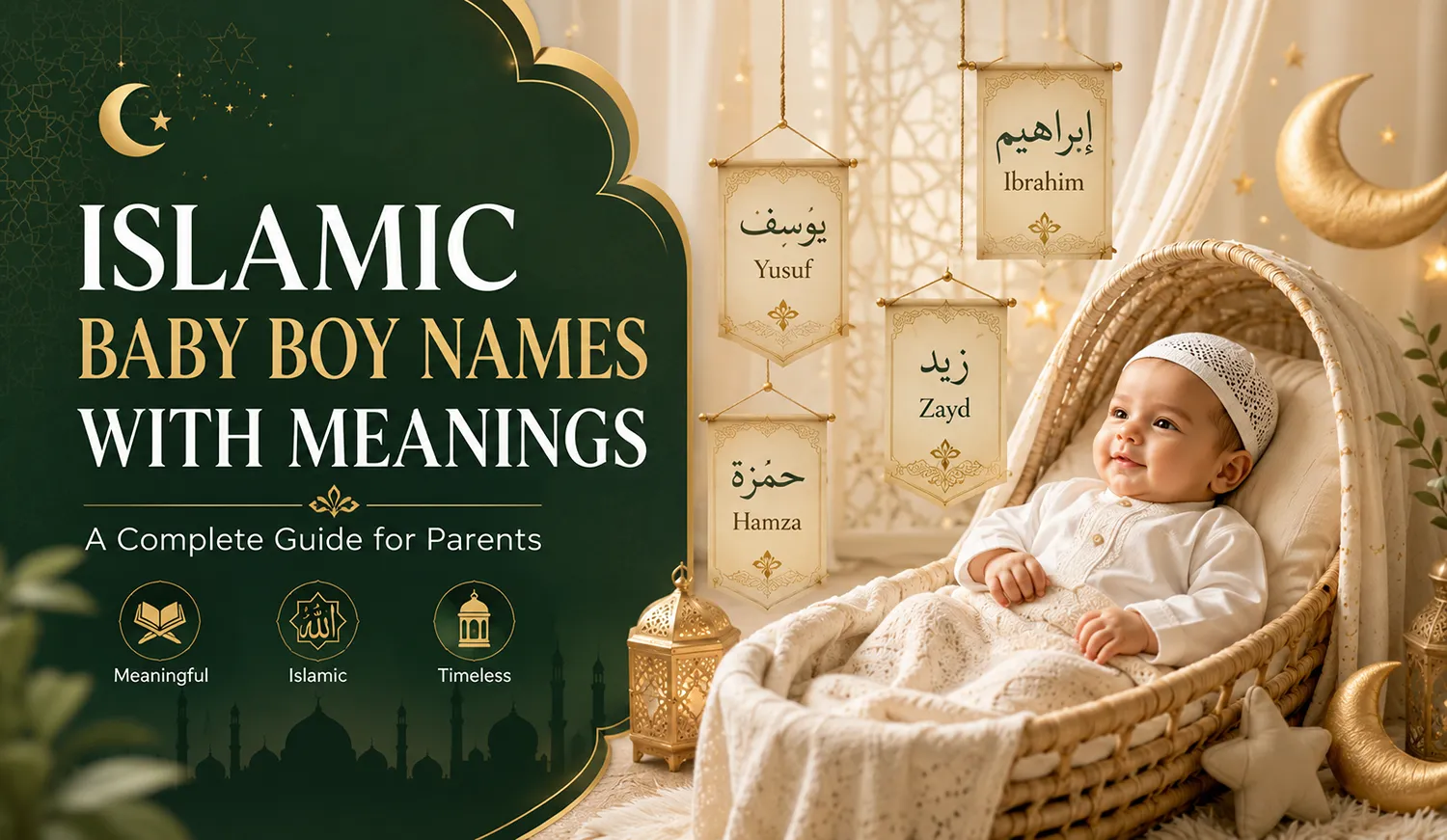
Islamic Baby Boy Names with Meanings: A Complete Guide for Parents in 2026
Choosing Islamic baby names is one of the sweetest and most nerve-wracking jobs new parents take on. You want something that will look good on a playground in twenty years, but you also want it to have some meaning. In Islam, a name is not just a label. It’s a little prayer you say every single day of your child’s life. This guide tells you how to choose a name your son can be proud of, along with the true meaning, origin, and some traditions about naming that are often left out of online “top 50 names” lists.
Why is naming your son important in Islam?
Names in Islamic tradition are not chosen randomly. Many parents look for something connected to the Quran, the prophets, or the companions of the Prophet Muhammad (peace be upon him), because a name is thought to reflect how a child sees themselves. A boy named Ibrahim grew up hearing the story of a prophet known for his courage and unwavering faith. A boy named Kareem is reminded of generosity whenever someone calls him by his name.
That’s part of why many families spend weeks – sometimes months – thinking about a name before their baby arrives. If you want to dig deeper into where these meanings actually come from, our team at Quran Janaan regularly covers the linguistic roots of Arabic words, including our breakdown of the meaning of Habibi in Arabic and Islam, which shows how an Arabic root can carry layers of meaning that are often lost in translation.

How to Choose a Good Islamic Name for Your Baby
There is no single “right” way to choose a name, but scholars and Islamic naming guides generally agree on a few things that are worth checking before you commit:
The meaning should be positive. Avoid names that have negative, arrogant, or unbelieving connotations.
Avoid names that are specific to Allah alone, such as Al-Khaliq (Creator) or Al-Malik (King), unless paired with “Abd” (servant) – Abdul Malik.
Pronunciation Issues: A name that is consistently mispronounced or mocked can really affect a child growing up, especially outside of Muslim-majority countries.
Check the family name combination. Say the full name out loud a few times before finalizing it.
Many parents also want to understand the original Arabic behind a name rather than just copying a meaning from a random list. If this is you, it’s worth spending time with our Learn Quran in English course, where commentary and translation are taught side by side so that words start to feel familiar rather than foreign.
Islamic Baby Boy Names Inspired by the Prophets
Prophetic names remain some of the most requested Islamic baby boy names, and for good reason — they connect a child to a story of faith that’s thousands of years old.
| Name | Meaning | Origin |
|---|---|---|
| Ibrahim | Father of many nations | Arabic (Prophet Ibrahim) |
| Ismail | God will hear | Arabic (Prophet Ismail) |
| Yusuf | God increases | Arabic (Prophet Yusuf) |
| Yahya | God is gracious | Arabic (Prophet Yahya) |
| Ishaq | He laughs | Arabic (Prophet Ishaq) |
| Musa | Drawn out of water | Arabic (Prophet Musa) |
| Idris | Studious, diligent | Arabic (Prophet Idris) |
| Ilyas | Devotion to God | Arabic (Prophet Ilyas) |
Names like Ahmad and Muhammad—both directly connected to the Prophet Muhammad—have become some of the most common Muslim boy names around the world, largely because parents want their sons to be connected to his character and legacy. If you want your child to grow up knowing these stories rather than just names, it’s helpful to read his life story early on—our roundup of the top Islamic books every Muslim should read includes a few biographies worth keeping on the family bookshelf.
Meaningful Arabic Names for Boys and What They Mean
Not every beautiful Islamic name comes from a prophet’s story. Many names are derived directly from Arabic words that describe the qualities parents hope their sons will grow up to have.
Popular Modern Islamic Baby Boy Names
Currently, a mix of classic and modern Islamic boys’ names is trending in Muslim families in the UK, US, and South Asia:
| Name | Meaning |
|---|---|
| Ayan | Blessed, favored by God |
| Zain | Beauty, grace |
| Rayan | One of the gates of heaven |
| Ayhan | Kind |
| Zayd | Abundance, progress |
| Mikael | A variant form of the angel Michael |
| Adam | First man, father of humanity |
| Hamza | Lion, strong |
The trend-setting is no less meaningful, though – most of them still have genuine Islamic or Quranic roots, just expressed in a way that feels a bit more modern.
Unique and Rare Islamic Boys’ Names with Deep Meaning
These are less common if you want to avoid three other baby names in the same class, but are still firmly rooted in Islamic tradition:
| Name | Meaning / Background |
|---|---|
| Zubayr | Strong, powerful; companion of the Prophet |
| Uthman | A baby snake; the name of the third caliph |
| Anas | Friendship, companionship |
| Bilal | Moisture, freshness; formerly the name of the muezzin |
| Harith | Cultivator, provider |
| Mazin | Rain cloud |
| Wasim | Handsome |
| Waqar | Dignity, respect |
Understanding what these names really mean – instead of just copying the spelling – is much easier once you can read a little bit of the source language yourself. That’s why families who go through our Quran translation course often tell us that they start seeing the meanings of Arabic names everywhere, from the Quran to everyday conversation.
The Sunnah of Aqiqah: Naming Ceremony Traditions
Naming a child in Islam is closely tied to Aqiqah — a Sunnah practiced at the birth of a child, where an animal (or two, in the case of a boy) is sacrificed as an act of gratitude to Allah. According to Islamic Relief, this practice is rooted in the Sunnah of Prophet Muhammad ﷺ, with two animals traditionally sacrificed for a baby boy as a virtuous, charitable act. The meat is typically shared with family, neighbors, and those in need — turning the naming moment into an act of charity as well as celebration.
Many families also recite specific duas around the birth and naming of a child, asking Allah for the child’s protection and guidance. If you’re building a habit of daily supplications for your growing family, our post on the Ya Dafi’al Baliyat dua is a good place to start, especially for parents navigating the stress of a new baby.
Common Mistakes to Avoid When Naming Your Son
A few things worth double-checking before the name goes on the birth certificate:
Don’t rely only on translated meanings from unfamiliar websites. Meanings can shift subtly depending on the Arabic root and dialect — cross-check with more than one source.
Don’t pick a name purely for trend value. A name your son will carry his whole life should mean something to you beyond what’s popular this year.
Don’t skip the pronunciation check. Say it with your last name, say it fast, say it the way a teacher or coworker might mispronounce it.
Don’t assume every “Islamic-sounding” name is actually Islamic. Some names are simply regional or cultural rather than religious in origin — which is fine, but it’s worth knowing the difference.
If Arabic still feels like a puzzle rather than a language you can read confidently, that’s genuinely common — it’s the exact gap our learn Quran online programs and Quran recitation classes are built to close, one lesson at a time. Plenty of parents who go through this naming process also end up thinking further ahead — toward the day their son starts his own Quran memorization (Hifz) journey, which is a whole different kind of naming: learning to carry Allah’s words by heart, not just a name given at birth.
Conclusion
At the end of the day, Islamic baby boy names are about more than sound and style — they’re a quiet form of dua you offer your son before he can even understand it. Whether you go with a Prophetic name like Ibrahim, a virtue-based name like Karim, or something trending like Ayaan, the meaning behind it matters more than the popularity ranking. Take your time, say it out loud a hundred times, ask your family, and check the meaning against more than one source before it’s final.
If this whole journey has you wanting to understand the Quran and Arabic behind these names a little better — not just for your son’s name, but for your own connection to the deen — take a look at our full course catalogue or register for a free trial class with Quran Janan. It’s a small first step, but it tends to open up a lot more than expected.
FAQ
Q1: What is the most popular Islamic baby boy name?
Muhammad and Ahmad remain among the most popular Islamic boy names globally, both tied directly to Prophet Muhammad ﷺ. Names like Ibrahim, Yusuf, and Ali also rank consistently high across Muslim communities.
Q2: Is it okay to name my son after a prophet?
Yes — naming a child after a Prophet is widely encouraged in Islamic tradition, as it’s believed to connect the child to that Prophet’s character and story. Many parents specifically choose prophetic names for this reason.
Q3: Can I use an Arabic name that isn’t strictly Islamic?
Yes, as long as the meaning is positive and doesn’t contradict Islamic values. Not every Arabic name has religious origins — some are simply cultural — but they’re still permissible as long as the meaning is good.
Q4: What is Aqiqah, and how does it relate to naming?
Aqiqah is a Sunnah practice performed shortly after a child’s birth, where an animal is sacrificed as a form of gratitude to Allah – traditionally two animals for a boy. It’s often combined with the formal announcement of the child’s name and shaving the baby’s head.
Q5: How do I check if a name’s meaning is accurate?
Cross-check the name across a few different sources, ideally ones that show the Arabic root word, not just an English translation. Meanings can shift depending on dialect, so it helps to ask someone who reads Arabic directly, such as a Quran teacher.
Q6: Should I prioritise meaning or popularity when naming my son?
Meaning should come first. A trending name with a weak or unclear meaning won’t carry the same long-term value as a name rooted in something meaningful, even if it’s less common.