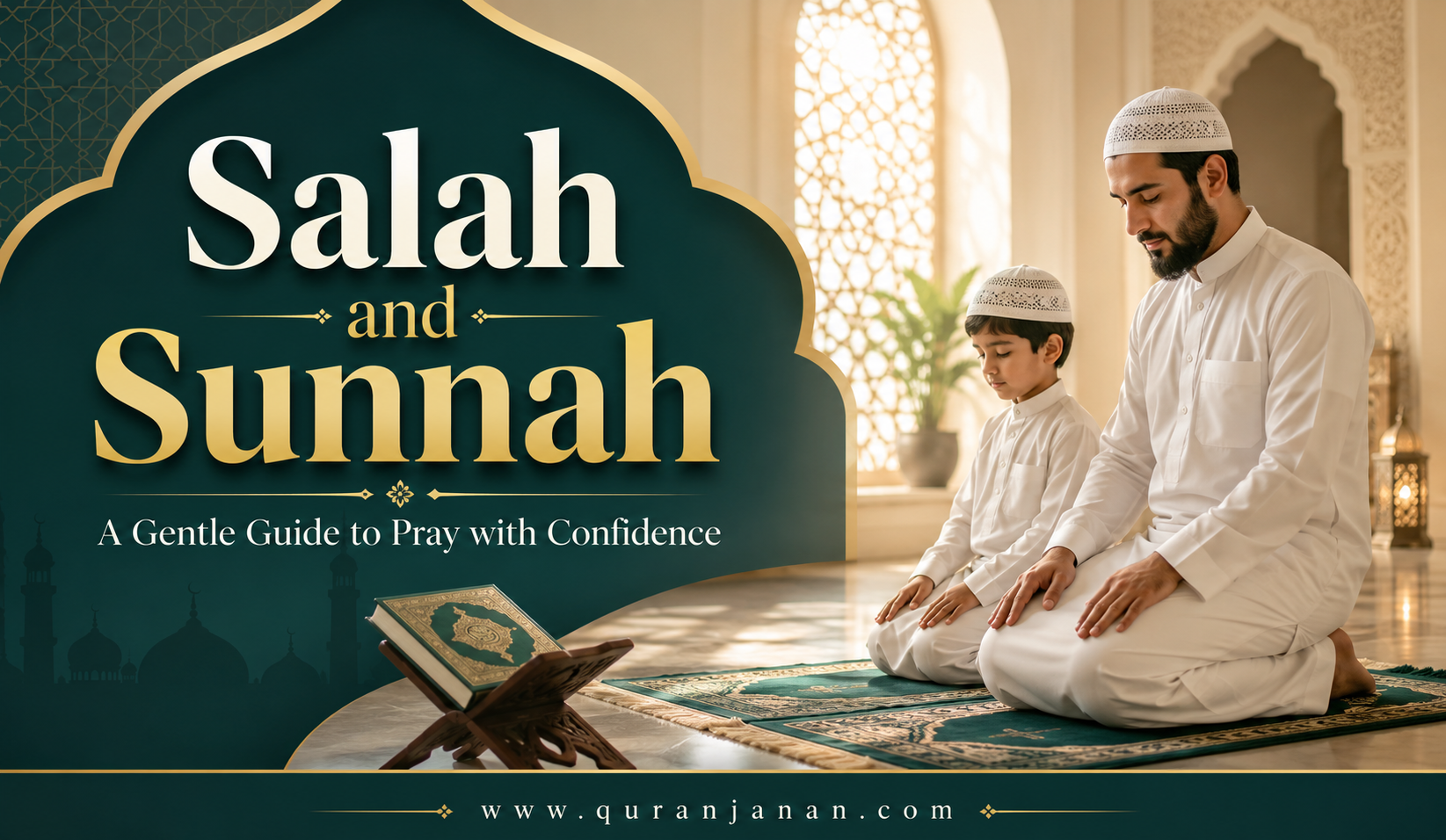
Prayer and Sunnah: A Complete Guide to Praying with Confidence
Prayer and Sunnah are closely related because Muslims pray by following the command of Allah and the practice taught by the Messenger of Allah (peace and blessings of Allah be upon him).
The obligatory parts of prayer are required, while the Sunnah acts and Sunnah supplications help make a Muslim’s worship complete, beautiful, and strong.
Beginners and families can learn to pray step by step by understanding the basics, correcting their recitation of the Quran, practicing regularly, and learning from a qualified teacher.
Introduction
A young boy stands next to his father for Maghrib. He raises his hands, tries to follow the movements, and whispers the words he remembers. After the prayer, his father gently corrects him with love, not anger. “Little by little,” he says, “we learn to pray step by step.”
Many Muslim families have moments like this. Some children are learning how to pray. Some adults want to return to prayer but feel unsure. Some beginners ask about prayer and sunnah because they want to know what is required, what is recommended, and how to pray according to the Quran and Sunnah.
Prayer and Sunnah mean understanding prayer as Allah Almighty has commanded it and learning how the Prophet Muhammad (peace and blessings of Allah be upon him) taught Muslims to pray. The obligatory parts of prayer are essential, while the Sunnah actions and Sunnah prayers add to the beauty, order, and reward.
In this guide, you will learn what prayer and sunnah mean, why they are important in Islam, how to start learning prayer correctly, common mistakes to avoid, and how Quran Janan Academy helps children, adults, and families.
What is prayer and sunnah?
A simple definition
Prayer is an obligatory prayer that Muslims perform daily, and sunnah refers to the way that the Prophet Muhammad (peace and blessings of Allah be upon him) taught, practiced, and encouraged prayer.
Prayer includes standing, recitation, bowing, prostration, sitting, remembrance, and supplication. Sunnah helps Muslims understand the correct manners, movements and postures, recommended prayers, and beautiful habits associated with prayer.
Common Misunderstandings.
A common misconception is that Sunnah means something unimportant. This is not true.
Fard actions are required, and Sunnah actions are extremely valuable because they follow the way of the Prophet Muhammad (peace and blessings of Allah be upon him). Sunnah prayers and Sunnah actions help strengthen worship and prevent the heart from thinking of prayer as just a routine.
Another misconception is that beginners should learn every detail at once. Beginners should start with the basic structure of prayer, then gradually learn the Fard, Sunnah, Tajweed, meanings and proper manners.
Question: What is Salat and Sunnah?
Prayer is the daily prayer that Muslims perform as an act of worship, while Sunnah is the Prophetic way of praying. Prayer and Sunnah together help Muslims pray with accuracy, humility, and love for Allah.
Why are prayer and Sunnah important in Islam?
Prayer is one of the most important acts of worship in Islam. It connects Muslims with Allah throughout the day and teaches discipline, humility, remembrance, and obedience.
The Quran repeatedly commands believers to establish prayer. The Sunnah of the Prophet Muhammad (peace and blessings of Allah be upon him) explains how Muslims should pray in practice. This is why Muslims learn both the commandment of prayer and the prophetic way of prayer.
According to Islamic scholars, learning prayer should be done with sincerity, patience, and proper guidance. A Muslim should not only know the movements but should also strive to improve recitation, concentration, manners, and consistency.
Prayer also affects daily life. It reminds a Muslim to pause, remember Allah, ask for forgiveness, and live with better character. For children, it forms an Islamic routine. For adults, it can be a path back to faith.

Question: Why is Sunnah important in prayer?
Sunnah is important in prayer because it teaches Muslims how the Prophet (peace and blessings of Allaah be upon him) prayed and guided his community. Following the Sunnah helps make prayer more complete, disciplined, and spiritually meaningful.
Traditional Islamic teaching teaches that prayer is learnt through knowledge and practice. A teacher, parent, or trusted Islamic leader can help beginners understand the difference between Fard and Sunnah without confusion.
Fard and Sunnah Prayers: What Beginners Should Know
Understanding Fard and Sunnah Prayers helps beginners pray with more confidence. Different schools of Islamic law may explain some details differently, so students should learn from a qualified teacher and follow reliable guidance.
Fard in Prayer
Fard refers to something that is required. If the fard part of a prayer is missing, the prayer cannot be valid according to Islamic Sharia guidance.
Common examples discussed in basic education include making the intention, standing when able, reciting, bowing, prostrating, and completing the prayer in the correct order. Beginners should learn this carefully with a teacher.
Sunnah in Prayer
Sunnah refers to the prophetic practice associated with prayer. These may include prescribed actions, manners, additional supplications, and ways to beautify the act of worship.
Sunnah does not mean “not worthy”. It means following the beloved example of the Prophet Muhammad (peace and blessings of Allah be upon him).
Sunnah Duas
Sunnah prayers are voluntary prayers that are attached to daily prayers, such as before or after certain obligatory prayers. They help a Muslim strengthen his worship and remember more regularly throughout the day.
Question: What is the difference between Fard and Sunnah prayers?
The obligatory parts of prayer are required, while Sunnah parts and Sunnah prayers follow the practice and guidance of the Prophet Muhammad (peace and blessings of Allah be upon him). Beginners should first learn the Fard, then gradually add the Sunnah actions and supplications.
How to perform prayer according to the Quran and Sunnah?
Learning how to pray according to the Quran and Sunnah should be gentle, systematic, and practical.
Step 1: Learn the basic structure of prayer.
Beginners should first learn the order of prayer:
Intention
Takbir
Standing.
Recitation of the Quran
Ruku
Standing after Ruku
Sujood
Sitting
Second Sujood
Final Sitting
Salam
This gives the student a clear outline. Once the structure is understood, the details become easier.
Step 2: Master Surah Al-Fatiha and Short Surahs.
Quran recitation is a major part of prayer. Many beginners know the movements but feel unsure about Surah Al-Fatiha, the short surahs, or pronunciation.
Certified Quran teachers often recommend mastering Surah Al-Fatiha first because it is recited in every rak’ah. Tajweed and muqrish help students pronounce the letters more clearly and confidently.
Parents can help their child by saying, “Today we will only practice Surah Al-Fatiha.” This keeps learning calm and focused.
Step 3: Learn the obligatory parts first, then the sunnah
Beginners should not feel overwhelmed. Learn the required parts first. Then learn the sunnah actions, sunnah supplications, supplications, and meanings step by step.
This method helps both children and adults to be consistent.
Best Answer
How to pray according to the Quran and Sunnah:
Learn the basic structure of prayer.
Understand the obligatory parts of prayer.
Correct recitation of Surah Al-Fatiha.
Learn short Surahs for prayer.
Practice the movements gradually.
Gradually add Sunnah actions and supplications.
Learn from a qualified teacher when possible.
Step 4: Practice daily with patience.
Repetition makes prayer easier. Children learn by watching adults. Adults improve by practicing regularly and correcting one mistake at a time.
Question: Can beginners learn prayer step by step?
Yes, beginners can learn prayer step by step, starting with the main movements, Surah Al-Fatiha, short Surahs, and basic supplications. Then they can gradually learn the Fard, Sunnah, meanings, and Tajweed.
Common mistakes and how to avoid them.
Learning prayer is a journey. Mistakes should be corrected with patience, not shame.
Mistake 1: Trying to learn everything at once
Some beginners try to learn every detail in one day. This can feel overwhelming.
The solution is to learn in stages. Start with the basics, then improve gradually.
Mistake 2: Neglecting Quran recitation
Some people learn the movements but do not read the Quran correctly. Since the Quran is recited in prayer, pronunciation is important.
The solution is to have a teacher recite Surah Al-Fatiha and short surahs for correction.
Mistake 3: Mixing up Fard and Sunnah
Some beginners feel confused about what is required and what is recommended.
The solution is to study with a qualified teacher and follow reliable Islamic guidance. Avoid random online confusion.
What mistakes should I avoid?
Avoid trying to learn everything at once, neglecting the recitation of the Quran, and confusing the details of Fard and Sunnah. Prayer becomes easier when beginners learn step by step with the guidance of teachers and daily practice.
A calm mindset helps. Don’t be embarrassed if you are learning late. Returning to prayer is a beautiful step.
Advice for Adults and Muslim Families Worldwide
Since Quran Janan Academy serves global students, families need Islamic education that is relevant to real life. Muslim families in the USA, UK, Canada, Australia, Pakistan, the Gulf, and Europe may have different school hours, work schedules, access to mosques, and time zones.
For adults, start with the basics. Learn how to pray. Recite the correct Surah Al-Fatiha. Learn short Surahs. Understand one prayer phrase each week. Don’t feel ashamed if you’re starting later in life.
For parents, children learn prayer through example. If they see their parents praying calmly and consistently, they will naturally begin to understand the importance of prayer.
For Islamic children, use short reminders. Say, “Prayer is how we remember Allah,” or “We follow the Sunnah because we love the Messenger of Allah (peace and blessings of Allah be upon him).”
A simple family routine could be:
Recite a prayer together daily
Practice Surah Fatiha
Learn a short Surah
Learn a Sunnah habit
Supplication after prayer
Review weekly with a teacher
According to Islamic scholars, small, consistent steps can shape worship over time. So start slowly and build up consistently.
How Quran Janan Academy helps students
Quran Janan Academy helps children, adults, and Muslim families through online Quran and Islamic education that fits into a home routine. It aims to help students confidently learn the Quran, prayer, Tajweed, and Islamic basics.
For beginners, Noorani Qaida’s classes help students learn Arabic letters, movements, joining, pronunciation, and basic Quran recitation. This foundation supports better recitation in prayer.
For students who want to improve their prayer recitation, Tajweed classes help improve pronunciation, fluency, pauses, rhythm, and intonation.
For children, Quran for Kids classes are gentle, structured, and age-appropriate. Teachers can help children learn short surahs, Quran recitation, supplications, and basic Islamic manners.
Quran for Adults. Adult classes allow learners to start or restart without embarrassment. Adults can practice Surah Fatiha, short surahs, Quran recitation, and the basics of prayer.
The memorization program supports memorization and revision for students who want to strengthen their Quran learning. Female Quran teachers are available for sisters and families who prefer female education.
Online Quran classes provide personalized attention to each student. Free trial classes help families assess a student’s level before choosing a regular plan.
Frequently Asked Questions
1. What is Salat and Sunnah?
Salat is the daily prayer that Muslims perform, and Sunnah is the prophetic way of worship taught by the Prophet Muhammad (peace and blessings of Allah be upon him). Salat includes the essential prayer actions, while Sunnah helps Muslims pray with better manners, consistency, and love. Tip: Learn the basic structure of Salat first.
2. What is the difference between Fard and Sunnah prayers?
Salat Fard refers to the required parts of Salat, while Sunnah refers to the prophetic actions associated with Salat. Fard should be learned first because it affects the foundation of Salat. Sunnah increases goodness and reward. Tip: