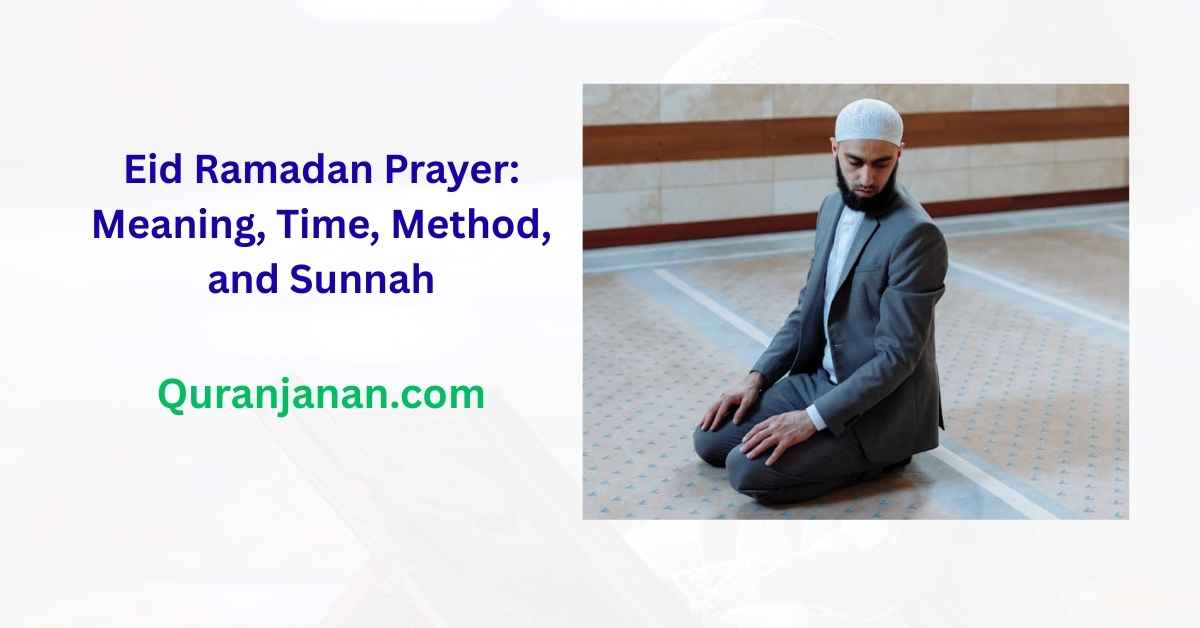
The Eid Ramadan prayer is the spiritual climax of a full month of fasting, reflection, and self-discipline.
It marks the joyful moment when Muslims gather to thank Allah for helping them complete Ramadan.
From my 20 years of teaching Islamic studies at Quran Janan, I have seen how Salat al-Eid unites families, strengthens community bonds, and renews faith in a way few other acts of worship can.
Many Muslims attend the Eid prayer every year.
But they often do not fully understand its meaning, proper time, method, or Sunnah rulings.
This guide explains the Eid Ramadan prayer step by step, supported by Quranic evidence, authentic hadith, and real-world teaching experience.
It also highlights common mistakes, spiritual benefits, and how to keep Ramadan habits alive after Eid.
Eid Ramadan Prayer
Understanding the Meaning of the Eid Prayer
After a full month of fasting, reflection, and discipline, Eid arrives as a moment of gratitude and joy. The prayer of Eid, known as Salat al-Eid, is the most important act of worship on the morning of Eid al-Fitr. In my 20 years of teaching Islamic studies at Quran Janan, I have seen how this prayer unites families and communities in a way few other acts of worship can.
Why the Eid Prayer Matters
The Eid prayer is not merely a ritual; it is a public expression of thanks to Allah for granting us the strength to complete Ramadan. It represents forgiveness, renewal, and spiritual rebirth. The Prophet Muhammad ﷺ never abandoned this prayer, highlighting its importance for both men and women.

Quranic Evidence Connecting Eid to Gratitude
Although the Qur’an does not mention the Eid prayer by name, Allah links the completion of Ramadan to glorifying Him:
وَلِتُكْمِلُوا الْعِدَّةَ وَلِتُكَبِّرُوا اللَّهَ عَلَىٰ مَا هَدَاكُمْ وَلَعَلَّكُمْ تَشْكُرُونَ
“So that you may complete the number and glorify Allah for that which He has guided you to, and perhaps you will be grateful.”
— Surah Al-Baqarah (2:185)
This verse forms the spiritual foundation for the Eid salah, connecting it to takbeer and gratitude.
Sunnah Evidence for Salat al-Eid
Umm ‘Atiyyah (رضي الله عنها) reported:
أَمَرَنَا رَسُولُ اللَّهِ ﷺ أَنْ نُخْرِجَهُنَّ فِي الْفِطْرِ وَالْأَضْحَى
“The Messenger of Allah ﷺ commanded us to bring out women on the day of Eid al-Fitr and Eid al-Adha.”
— Sahih al-Bukhari & Muslim
This hadith proves that attending the Eid prayer is a highly emphasized Sunnah.
Time of the Eid Prayer
The time begins shortly after sunrise and lasts until just before Dhuhr. Scholars recommend performing it early on Eid al-Fitr so people can return home and enjoy food after fasting for a month.
Where It Is Performed
Traditionally, Muslims pray in open fields (Eidgahs) or large mosques. The Prophet ﷺ preferred open spaces, which highlights the communal spirit of Eid.
How the Eid Prayer Is Performed
The prayer consists of two rak‘ahs with extra takbeers. In the first rak‘ah, seven takbeers are recited after the opening takbeer. In the second rak‘ah, five takbeers are recited before Surah al-Fatihah. This method is based on authentic narrations.
The Khutbah After the Prayer
Unlike Jumu‘ah, the khutbah is delivered after the prayer. The imam reminds people about gratitude, charity, family ties, and maintaining good deeds after Ramadan.
Zakat al-Fitr Before the Prayer
Ibn ‘Umar (رضي الله عنه) reported:
فَرَضَ رَسُولُ اللَّهِ ﷺ زَكَاةَ الْفِطْرِ طُهْرَةً لِلصَّائِمِ
“The Messenger of Allah ﷺ made Zakat al-Fitr obligatory as a purification for the fasting person.”
— Abu Dawood
It must be paid before the Eid prayer so the poor can also celebrate.
Takbeer on the Morning of Eid
From Fajr until the prayer begins, Muslims recite:
اللَّهُ أَكْبَرُ اللَّهُ أَكْبَرُ، لَا إِلَهَ إِلَّا اللَّهُ، وَاللَّهُ أَكْبَرُ وَلِلَّهِ الْحَمْدُ
“Allah is the Greatest… and all praise is for Allah.”
This fills the atmosphere with joy and remembrance.
The Sunnah of Eating Before Prayer
Anas (رضي الله عنه) reported:
كَانَ رَسُولُ اللَّهِ ﷺ لَا يَغْدُو يَوْمَ الْفِطْرِ حَتَّى يَأْكُلَ تَمَرَاتٍ
“The Messenger of Allah ﷺ would not go out on Eid until he had eaten some dates.”
— Sahih al-Bukhari
This confirms that fasting has ended.
Dress and Cleanliness
Wearing clean and beautiful clothes is a Sunnah. The Prophet ﷺ had a special garment for Eid, teaching Muslims to honor the day.
The Eid Greeting
Muslims greet one another with:
“Taqabbal Allahu minna wa minkum”
(May Allah accept from us and from you).
Women and Children
Women and children are encouraged to attend. Even those not praying due to menstruation should witness the blessings and joy.
If Someone Misses the Prayer
Scholars allow two rak‘ahs at home as a replacement, though the congregational prayer remains best.
Praying at Home in Special Circumstances
Illness or public restrictions allow families to pray at home while keeping the Sunnah alive.
The Emotional Impact
Standing shoulder to shoulder after Ramadan brings tears to many eyes. I’ve personally seen students overwhelmed with gratitude as they realize how Allah carried them through the month.
Maintaining Ramadan Habits
The real success of Eid is continuing good deeds afterward—prayer, Qur’an, charity, and self-discipline.
Teaching Children Its Meaning
At Quran Janan, we teach children why they pray Eid salah, not just how, so they grow up loving worship.
Common Mistakes
Some people skip the Eid prayer thinking it is optional. While scholars differ on its ruling, all agree it is a great loss to miss without a valid excuse.
Unity of the Ummah
The sight of thousands praying together reflects the unity of Islam—rich and poor standing equally before Allah.

FAQ Answers
Q1: Is it 6 or 12 takbeer in Eid prayer?
Answer:
Is it 6 or 12 takbeer in Eid prayer? Eid prayer has 6 extra takbeers (3 in each rakat) according to most scholars.
Some schools count 12 total (including opening takbeer), but the common practice is 3 extra takbeers in the first rakat and 3 in the second.
Q2: How many rakats are in Eid prayer?
Answer:
How many rakats are in Eid prayer? Eid prayer consists of 2 rakats.
It is prayed in congregation and includes additional takbeers not found in regular Salah.
Q3: How to pray Eid ul-Fitr prayer at home?
Answer:
How to pray Eid ul-Fitr prayer at home? Pray 2 rakats with extra takbeers, recite Surah Al-Fatihah and another Surah in each rakat.
If alone, you can pray without a khutbah. Follow the same format as congregation prayer but skip the sermon.
Q4: Is Eid prayer Sunnah or nafl?
Answer:
Is Eid prayer Sunnah or nafl? Eid prayer is Wajib (obligatory) in the Hanafi school and Sunnah Mu’akkadah in other schools.
It is strongly recommended and should not be missed without a valid excuse.
Q5: Can I pray Eid prayer at home by myself?
Answer:
Can I pray Eid prayer at home by myself? Yes, you can pray Eid prayer at home alone if you miss the congregation.
Scholars allow it, especially in situations like illness or travel.
Q6: How to do Eid prayer at home for ladies?
Answer:
How to do Eid prayer at home for ladies? Women can pray 2 rakats at home with extra takbeers.
It can be prayed alone or in a group without a khutbah. The method is the same as men’s Eid prayer.
Q7: Can I pray Eid Salah without wudu?
Answer:
Can I pray Eid Salah without wudu? No, wudu is required for Eid prayer like any other Salah.
Without wudu, the prayer is not valid and must be repeated.
Q8: What time should I pray Eid prayer at home?
Answer:
What time should I pray Eid prayer at home? Eid prayer time starts after sunrise and lasts until before Zuhr.
It is best to pray about 15–30 minutes after sunrise.
Q9: Can a woman pray Eid prayer at home alone?
Answer:
Can a woman pray Eid prayer at home alone? Yes, a woman can pray Eid prayer at home alone.
It is valid and rewarded, especially if she cannot attend the mosque.
Q10: What are the 3 forbidden times to pray?
Answer:
What are the 3 forbidden times to pray? The three forbidden times are after Fajr until sunrise, when the sun is at its peak, and after Asr until sunset.
During these times, voluntary prayers are disliked or not allowed.
Q11: What are the Eid prayer rules?
Answer:
What are the Eid prayer rules? Eid prayer is 2 rakats, includes extra takbeers, and is prayed after sunrise.
A khutbah follows the prayer, and wudu is mandatory.
Q12: How many Takbir are there in Eid prayer?
Answer:
How many Takbir are there in Eid prayer? There are 6 extra takbeers in Eid prayer (3 in each rakat).
Some scholars include the opening takbeer and count 12 total.
Q13: Can you skip Eid prayer?
Answer:
Can you skip Eid prayer? Eid prayer should not be skipped without a valid reason.
It is obligatory (Wajib) in Hanafi fiqh and strongly recommended in other schools.
Q14: How to pray Eid Salah step by step?
Answer:
How to pray Eid Salah step by step? Start with niyyah, say Takbir, recite Surah Al-Fatihah and another Surah, then complete Ruku and Sujood.
Add 3 extra takbeers in each rakat before recitation in the first and before ruku in the second.
Q15: How to pray examples?
Answer:
How to pray examples? A basic prayer example includes standing (Qiyam), recitation, bowing (Ruku), prostration (Sujood), and sitting (Tashahhud).
Eid prayer follows the same structure with additional takbeers.
Q16: How to pray while sitting?
Answer:
How to pray while sitting? You can pray while sitting if you are ill or unable to stand.
Perform Ruku and Sujood by bowing your head, making Sujood lower than Ruku.