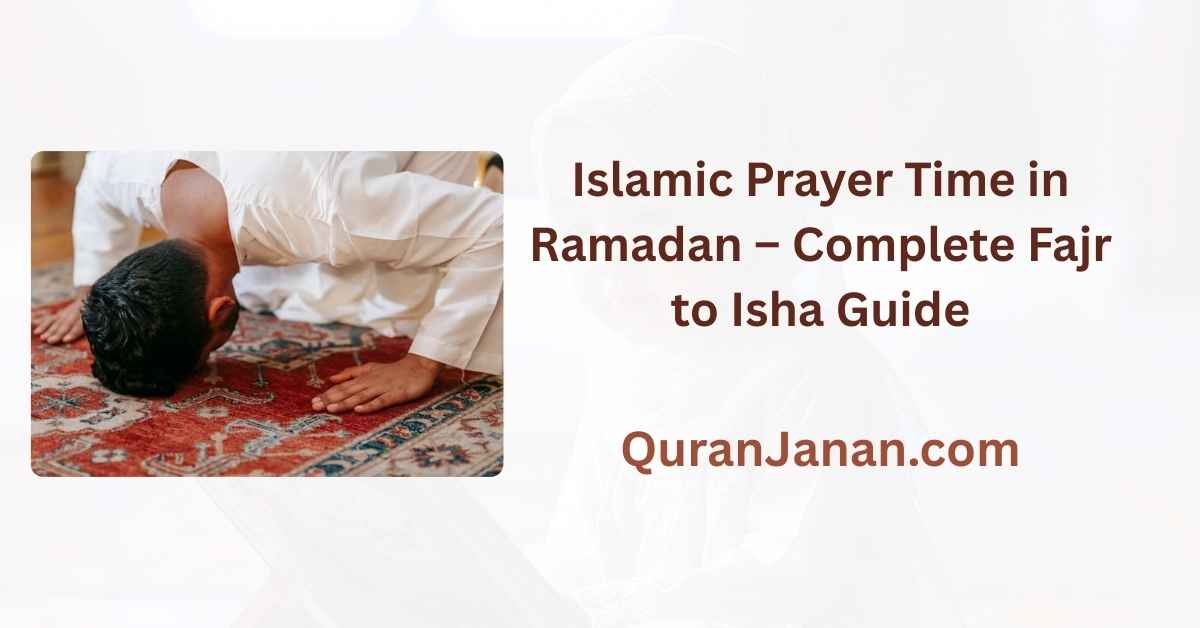
From my 20 years of experience teaching Islamic studies and guiding families at Quran Janan, I can confidently say that understanding Islamic prayer time in Ramadan is essential for observing this sacred month correctly. Ramadan is not only about fasting; it is about structuring your entire day around the worship of Allah through timely prayers, Quran recitation, and spiritual discipline. Knowing the exact prayer times during Ramadan ensures the validity of fasting, strengthens taqwa (God-consciousness), and helps Muslims maintain consistency in salah from Fajr to Isha, making Ramadan a truly transformative month of faith and obedience.
Islamic Prayer Time Ramadan
Introduction to Islamic Prayer Time in Ramadan
From my 20 years of experience teaching Islamic studies and guiding families at Quran Janan, I can confidently say that understanding Islamic prayer time in Ramadan is essential for observing this sacred month correctly. Ramadan is not only about fasting; it is also about strengthening one’s connection with Allah through timely prayers, Quran recitation, and increased acts of worship. Knowing the exact prayer times during Ramadan helps Muslims structure their day around obedience, discipline, and spiritual growth.
Importance of Prayer Timing in Islam
Islam places great emphasis on performing each prayer at its prescribed time. Allah says:
“Indeed, prayer has been decreed upon the believers a decree of specified times.”
— Surah An-Nisa (4:103)
This verse establishes that prayer timing is not optional but a divine obligation. During Ramadan, this becomes even more important because fasting, Suhoor, and Iftar are all directly connected to prayer times.
How Ramadan Changes Daily Prayer Routines
Ramadan naturally reshapes a Muslim’s daily schedule. The day begins before dawn with Suhoor and Fajr prayer, and it ends with Maghrib prayer and Iftar. Night prayers such as Isha and Taraweeh become central acts of worship. As a result, Muslims must be more conscious of prayer times throughout the day.

Fajr Prayer Time in Ramadan
Fajr marks the beginning of the fast. It starts at true dawn and ends at sunrise. Allah says:
“Eat and drink until the white thread of dawn becomes distinct to you from the black thread. Then complete the fast until sunset.”
— Surah Al-Baqarah (2:187)
This verse makes Fajr time critical, as eating or drinking must stop precisely at dawn. Performing Fajr on time sets the spiritual tone for the entire day of fasting.
Dhuhr Prayer Time in Ramadan
Dhuhr begins when the sun passes its zenith and lasts until the shadow of an object equals its length. In Ramadan, Dhuhr is often prayed quietly at home or in the mosque. It serves as a reminder to pause from daily work and reconnect with Allah, especially while fasting.
Asr Prayer Time in Ramadan
Asr begins when the shadow of an object is longer than its length and continues until sunset. This prayer is especially important because it comes during the most physically challenging hours of fasting. Observing Asr on time strengthens patience and discipline.
Maghrib Prayer Time and Iftar
Maghrib begins immediately at sunset and marks the end of the fast. The Prophet Muhammad ﷺ used to break his fast as soon as the sun set. He said:
“The people will remain upon goodness so long as they hasten to break the fast.”
— Sahih al-Bukhari & Sahih Muslim
Breaking the fast at the exact Maghrib time and praying Maghrib promptly is a Sunnah and a key element of Islamic prayer time in Ramadan.
Isha Prayer Time in Ramadan
Isha begins when the red twilight disappears from the sky and lasts until midnight (or before Fajr). In Ramadan, Isha prayer is often combined with Taraweeh, making it a deeply spiritual and communal experience in mosques and homes.
Taraweeh Prayer and Its Timing
Taraweeh is a special night prayer performed after Isha during Ramadan. The Prophet ﷺ prayed Taraweeh and encouraged others to do so. He said:
“Whoever stands in prayer during Ramadan with faith and seeking reward, his previous sins will be forgiven.”
— Sahih al-Bukhari & Sahih Muslim
Taraweeh has no fixed number of rak‘ahs, though 8 or 20 are commonly practiced. It should always be performed after Isha.
Tahajjud Prayer in the Last Ten Nights
In the last ten nights of Ramadan, many Muslims wake up for Tahajjud prayer. This voluntary prayer is performed in the final third of the night and holds immense spiritual reward, especially during Laylat al-Qadr.
Suhoor and Its Relation to Fajr Time
Suhoor must end before Fajr begins. The Prophet ﷺ said:
“Eat Suhoor, for in Suhoor there is blessing.”
— Sahih al-Bukhari
Delaying Suhoor close to Fajr while stopping in time is a Sunnah and helps maintain strength throughout the fasting day.
Why Accurate Prayer Times Matter in Ramadan
Accuracy in prayer times is critical because both fasting and prayer depend on precise timing. Starting the fast too early or breaking it too late can invalidate acts of worship. That is why Muslims rely on authentic prayer timetables, local mosque announcements, or trusted mobile apps.
Regional Differences in Prayer Times
Prayer times vary depending on geographical location. Muslims in different countries experience different lengths of fasting and prayer intervals. Islam recognizes this diversity and requires believers to follow local sunset and dawn times.
Using Technology for Prayer Time Tracking
Modern tools such as mobile apps, mosque websites, and digital clocks help Muslims track Islamic prayer time in Ramadan. These tools are beneficial, especially for families, travelers, and those living in non-Muslim countries.

Combining Prayers During Ramadan
In normal circumstances, combining prayers is not allowed except during travel or extreme hardship. Ramadan itself is not a valid reason to combine prayers. Each prayer must be performed within its proper time.
Teaching Children Prayer Times in Ramadan
Ramadan is an excellent opportunity to teach children about prayer discipline. Encouraging them to wake for Fajr, pray Maghrib at Iftar, and join Taraweeh builds lifelong habits of worship.
Common Mistakes About Prayer Times in Ramadan
Some people delay Maghrib unnecessarily, skip Dhuhr or Asr due to fatigue, or pray Isha too late without a valid reason. These habits reduce the spiritual impact of Ramadan and contradict Islamic teachings.
Spiritual Impact of Timely Prayers
Praying on time during Ramadan increases humility, focus, and closeness to Allah. It transforms fasting into a complete act of worship rather than a physical routine.
Personal Reflection From 20 Years of Teaching
Over two decades, I have observed that families who strictly follow prayer times during Ramadan experience a deeper sense of peace and unity. When prayer becomes the center of daily life, Ramadan becomes truly transformative.
Linking Prayer Times With Quran Recitation
Many Muslims connect Quran recitation with prayer times, such as reading Quran after Fajr, Dhuhr, or Taraweeh. This habit strengthens both spiritual consistency and Quranic connection.
The Wisdom Behind Structured Prayer Times
Allah designed prayer times to bring balance into human life. During Ramadan, this structure becomes even more meaningful, guiding believers from dawn to night with remembrance and discipline.
Final Understanding of Islamic Prayer Time in Ramadan
Islamic prayer time in Ramadan is a sacred framework that organizes worship, fasting, and daily life around obedience to Allah. By observing each prayer at its correct time, Muslims elevate their Ramadan experience spiritually and practically. At Quran Janan, we emphasize accurate prayer knowledge, authentic teachings, and heartfelt worship to help believers make the most of this blessed month.
FAQ Answers
1. Can I pray Fajr 3 minutes early?
No, Fajr prayer must be prayed after its time starts.
Fajr begins at true dawn (Subh Sadiq), not before. Praying even a few minutes early makes the prayer invalid, so it’s best to follow a verified prayer timetable.
2. Is Ramadan 1446?
Yes, the upcoming Ramadan is expected to be in 1446 AH.
The Islamic calendar is lunar, so exact dates depend on moon sighting in each region.
3. What are the 5 times to pray during Ramadan?
The five daily prayers are Fajr, Dhuhr, Asr, Maghrib, and Isha.
These prayer times stay the same during Ramadan, with the addition of Taraweeh after Isha.
4. In which time does Fajr end?
Fajr time ends at sunrise.
You must complete your Fajr prayer before the sun starts rising to make it valid.
5. Can you pray Tahajjud 20 minutes before Fajr?
Yes, Tahajjud can be prayed until just before Fajr.
The best time for Tahajjud is the last third of the night, ending when Fajr begins.
6. Can I pray Fajr at 4 am today?
You can pray Fajr at 4 am only if Fajr time has started in your area.
Always check your local prayer timetable or mosque schedule.
7. Can I kiss my wife in Ramzan?
Yes, kissing your wife is allowed if it doesn’t lead to arousal or intercourse.
If it leads to ejaculation or sexual activity, the fast becomes invalid.
8. Which year has 2 Ramadans?
Years like 2030 will have two Ramadans.
Because the Islamic year is shorter, Ramadan shifts earlier each year and occasionally occurs twice in one Gregorian year.
9. Why fasting on 13, 14, 15 is important?
These are the White Days (Ayyam al-Beed), recommended for voluntary fasting.
The Prophet ﷺ encouraged fasting on these days for extra reward.
10. Is 3am Tahajjud time?
Yes, 3 am is usually within Tahajjud time.
Tahajjud starts after Isha and ends at Fajr, with the last third of the night being the most virtuous.
11. Can I brush my teeth during Ramadan?
Yes, brushing your teeth while fasting is allowed.
Just be careful not to swallow toothpaste or water.
12. Is it 8 or 20 Rakats in Taraweeh?
Both 8 and 20 Rakats are valid.
Different schools of thought follow different practices, and both are acceptable in Islam.
13. Is it OK to read Quran from phone in Taraweeh?
Yes, reading Quran from a phone during Taraweeh is allowed.
Many scholars permit it, especially for those who haven’t memorized long portions.
14. Can I pray Taraweeh alone?
Yes, you can pray Taraweeh alone at home.
While congregation has more reward, praying alone is still valid.
15. How many Rakat Taraweeh are in Al-Aqsa Mosque?
Al-Aqsa Mosque traditionally prays 20 Rakats of Taraweeh.
This follows the long-standing practice in many major mosques.
16. What is the correct way to pray Taraweeh?
Taraweeh is prayed in sets of two Rakats after Isha.
It includes recitation of Quran, followed by Witr prayer to conclude the night prayer.